Iran’s Internet Kill Switch: Regime Survival Through Digital Isolation
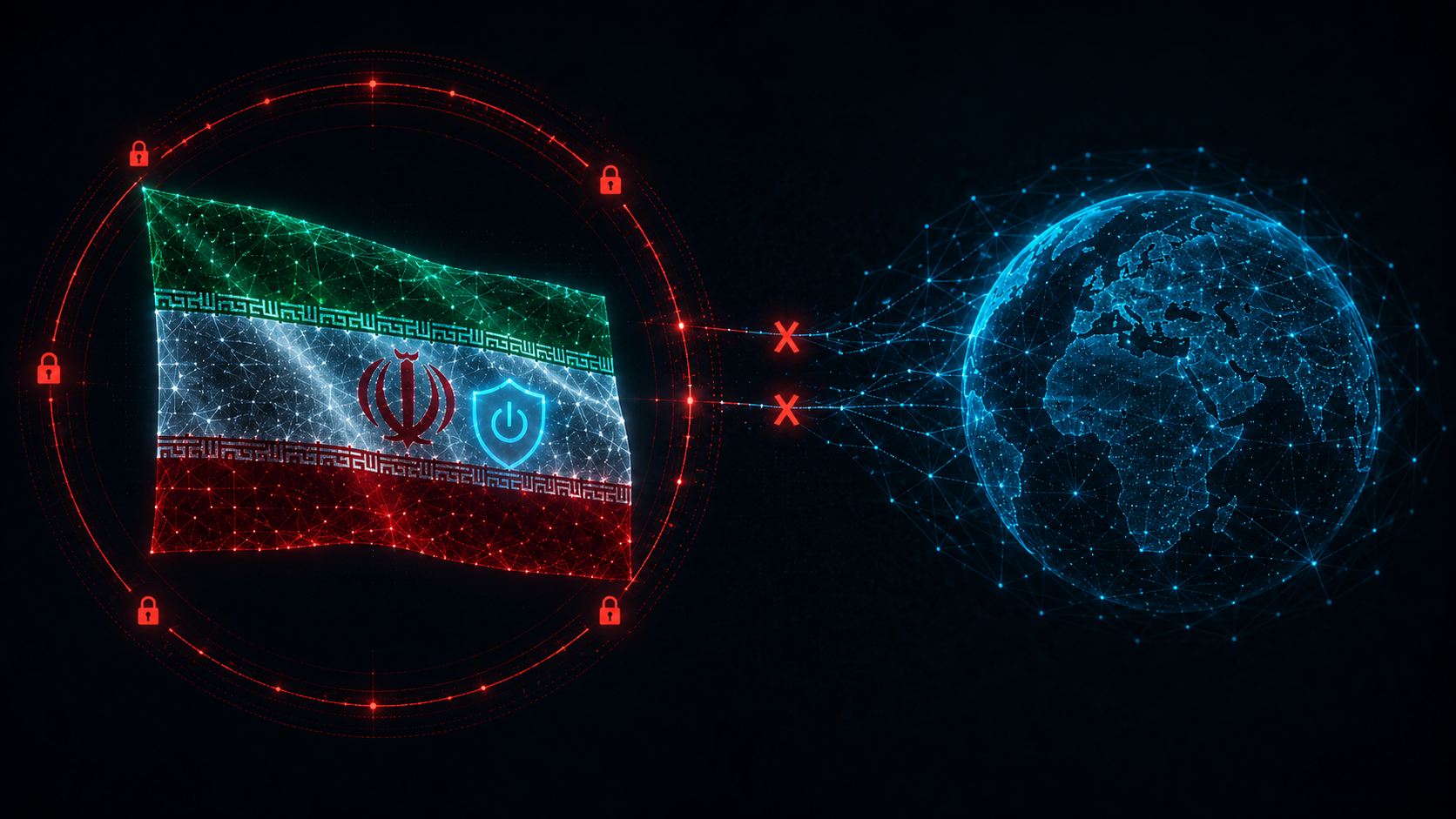
Iran’s National Information Network (NIN)
Introduction
On February 28, 2026, the United States and Israel launched a coordinated assault against the Islamic Republic of Iran. Subsequent operations aimed to destabilize the Iranian government through conventional strikes against infrastructure, and the decapitation of key leaders. The two allies also used cyber operations to blind Iranian sensors, disrupt communications, and complicate Tehran’s ability to coordinate an effective military response. They paired those battlefield effects with cyber-enabled psychological operations, including messages pushed through Iranian digital platforms along with statements from U.S. and Israeli leadership that urged Iranians to abandon the Islamic Republic and use the conflict as an opportunity for regime change.
Despite the calls, the uprising never came. Appeals for Iranians to seize the moment may have failed not because the message lacked force, but because Tehran controlled the channels it needed to travel. Since the conflict began, the regime’s internet blackout has undercut allied efforts to inspire resistance. According to NetBlocks, a digital rights organization, national connectivity flat-lined within 24 hours of the conflict to 1% of traditional levels. The blackout has since become “the longest nation-scale internet shutdown in any country on record.”
Creating a viable internet kill switch is no small feat. Disabling the internet means disabling critical economic platforms and societal services. For most countries, the resulting instability is too risky to be a viable strategy of authoritarian control, even without the added threat of U.S. strategic bombings. Iran, however, has spent more than a decade developing the National Information Network (NIN), giving the regime the infrastructure to sustain digital isolation while intensifying violence against its own citizens.
The Logic of Iran’s Internet Kill Switch
The NIN is a domestic cybersecurity initiative to establish a state-run intranet and reduce Iran’s dependence on the global internet. It is the cornerstone of Iran’s digital isolation strategy, which serves as a force multiplier of state repression. An operational NIN allows the Islamic Republic to disconnect from the rest of the world, forcing its citizens to turn towards official platforms that ensure the continued availability of essential services and enable the state to conduct widespread surveillance. Without the NIN, imposing an internet blackout would be a much more expensive and desperate endeavor that could worsen social unrest and cost the government an estimated $370 million each day to sustain.
The NIN spotlights how seriously Tehran views control over the information environment amid consistent coercive external pressure and internal unrest. Accordingly, Iranian officials developed the NIN with the same vulnerabilities in mind that the United States and Israel sought to exploit at the onset of the war. Civil unrest may be the Islamic Republic’s Achilles’ heel but the regime has built the NIN to silence, isolate, and repress anti-government dissent.
Building the NIN for Regime Security
The history of the NIN dates back to 2006, when the Iranian government first proposed legislation to establish a “government-controlled secure national network”. However, progress on the initiative languished for years. As a result, widespread protests in 2009, known as the Green Movement, took advantage of unregulated access to social media sites to document injustices, disperse rhetoric, and organize demonstrations. The state responded by blocking traffic to specific web services, but protestors used virtual private networks (VPNs) and intermediate servers to bypass such restrictions.
The Green Movement failed to overturn the disputed election of the Iranian president and dissipated under the stress of state repression. However, the demonstrations clearly conveyed the danger that the global internet can pose to authoritarian regimes. This lesson grew increasingly salient as similar movements spread across the Middle East and North Africa during the Arab Spring of 2011. Much like during the Green Movement, the proliferation of internet and social media access fueled civil unrest in Egypt, Libya, Yemen, and Syria. In these cases, however, Tehran witnessed state security forces fail to contain the popular uprisings, leading to various civil wars and regime changes.
In the wake of the Arab Spring, Iranian officials began to express interest in the creation of a “Halal Internet.” Behind the official intention of defending Islamic values from Western corruption, the state envisioned that such a network would be disconnected from the global internet and used to coerce the Iranian populace into adopting alternative platforms under “complete government control” for commerce and communication. In 2013, these ambitions started to materialize as official construction of the NIN began.
China, Russia, and the Sovereign Internet Model
The creation of the NIN follows an authoritarian precedent established by other states with similar interests in digital isolation. Perhaps the most extreme example is North Korea, which operates an intensely regulated intranet for a limited group of users. Likewise, China’s “Golden Shield” project managed the development of the nation’s digital infrastructure in the 1990s in conjunction with extensive digital censorship and surveillance capabilities. Today, the “Great Firewall” provides the Communist Party of China with robust surveillance and censorship capabilities. In fact, China’s enforcement of a ten-month blackout in 2009 during unrest in Xinjiang foreshadowed Iran’s modern strategy.
Unlike North Korea and China, however, Iran has had to develop its censorship strategy around a society already deeply integrated with the global internet. In this respect, Iran’s efforts are more consistent with Russian policies. In 2019, Russia enacted a “Sovereign Internet” law to centralize state control over domestic internet architecture with the intention of pursuing the digital isolation of Russia’s own internet, often referred to as the RuNet. Like the NIN, this strategy reflects continued dependence on global platforms and the availability of public information as major threats to regime-security.
Internet Blackouts as Cover for State Violence
2019 marked a turning point in Iran’s architecture of digital control. The state unveiled its “Digital Fortress” initiative to strengthen the resilience and cybersecurity of domestic infrastructure, which corresponded with the expansion of the NIN. Accordingly, the regime leveraged the NIN soon after to crush domestic opposition.
In November 2019, a spike in fuel prices triggered protests across Iran that quickly broadened into anti-government unrest. In response, the Islamic Republic implemented a “nearly complete disconnection of the Iranian ISPs (internet service providers)”. In the past, Iranian officials merely directed ISPs to block traffic to the web services used by protestors. This departure from traditional policy proved much more effective, as protestors could no longer circumvent censorship with VPNs or Tor services. With Iranian ISPs fully offline, reportedly 95% of domestic users were completely isolated from the internet altogether. At the same time, government-run services remained operational, ensuring that the state could continue to function without falling into further chaos.
By enabling extreme digital isolation and censorship, the NIN empowered the Islamic Republic to crack down with unprecedented intensity. During what would come to be known as “Bloody November,” the regime authorized security forces to use lethal force against protestors. Over the following days, observers estimated the death toll to be at least several hundred to potentially over a thousand. By comparison, the United States Institute of Peace estimates that the state killed roughly one hundred protesters during the first six months of the Green Movement in 2009.
The stark contrast between the Green Movement and Bloody November underscores the impact of the NIN; when the public had independent access to the internet, the state recognized that extreme violence could provoke organized resistance and incite further unrest. However, the ability to impose blackouts on demand significantly weakened the viability of this deterrent and incentivized the regime to pursue greater repression. Suddenly, the Iranian people could no longer rely on the internet to document injustices and rally mass protests. One photojournalist, Hossein Fatemi, resorted to physically smuggling photographs out of the country on flash drives. However, such evidence remained inaccessible to those trapped behind the NIN.
Since 2019, the Iranian regime has continued to leverage internet blackouts to deter domestic unrest, cementing the NIN as a reliable mechanism of authoritarian control. In 2022, the state ensured that “internet connectivity was virtually shutdown” leading up to its crackdown on the “Woman, Life, Freedom” movement, in which Iranian state forces would kill at least 103 citizens. More recently, the state implemented another blackout in June of 2025 amidst Israeli missile strikes and cyberattacks.
The NIN in 2026: Too Isolated to Rise Up?
The internet blackouts in the lead up to the U.S. and Israeli military strikes are another episode in a long history of authoritarian control through digital isolation. In December 2025, mounting economic instability and dissatisfaction with the government sparked mass demonstrations across reportedly 187 cities. By January 8, 2026, the Islamic Republic had once again disabled internet connectivity across the country. This time, the regime even introduced a new tactic: military jammers were deployed to prevent activists from connecting to the global internet via Starlink satellites. In the weeks that followed, reporters could only speculate about the death toll, as Iranian officials reportedly ordered security forces to “show no mercy” against protesters.
Amidst the chaos, the United States and Israel engaged Iran in military conflict with various stated objectives, including the destruction of nuclear enrichment capabilities and the promotion of freedom for the Iranian people. Despite Iran doubling down on its internet restrictions, cyber-operations have played a critical role in this war. According to Joint Chiefs of Staff Chairman Gen. Dan Caine, U.S. Cyber Command “effectively disrupted communications and sensor networks” in order to “disrupt, disorient and confuse the enemy.” Notable operations include Israel’s infiltration of mobile phone networks and traffic cameras across Tehran, which enabled the killing of Ayatollah Ali Khamenei. Additionally, an Iranian app, BadeSaba, was also hacked to display anti-regime messages and possibly compromise the location of key users.
After a few months of conflict, the Iranian regime remains intact. The protests that once captured global headlines appear to have subsided in the face of extreme and violent repression. Mass arrests, lethal force, and extrajudicial executions have emptied the streets, allowing the government to organize pro-regime demonstrations in their place. Although these efforts are likely masking deeper cracks in the state's authority, the continued resilience of the Islamic Republic and successful suppression of dissent has reasonably defied U.S. and Israeli expectations.
For now, the war’s outcome and long-term implications remain uncertain, especially given the NIN’s limitations. Iran’s Minister of Communications has acknowledged that the NIN cannot indefinitely replace the global internet, as its domestic infrastructure is unfinished and costly (with an estimated $36 million daily price tag for each day of the blackout). Even so, the NIN has undoubtedly transformed Iran’s repressive capabilities as a force multiplier of authoritarian control.
Until 2019, the Islamic Republic relied primarily on coercive force to deter civil unrest. But the memory of the Arab Spring, and of Iran’s own revolution in 1979, demonstrated that violence alone could not always contain widespread discontent. Accordingly, Iranian officials believed regime survival depended on more than bullets, batons, and prisons. It requires more control over the information environment itself. This knowledge formed the basis of the NIN initiative, in which Iran has spent more than a decade developing digital capabilities to prevent the domestic uprising that the United States and Israel are currently counting on.