Two years ago, then-Deputy Secretary Kathleen Hicks stood before the National Defense Industrial Association and issued a challenge to the Pentagon's "valley of death". The promise of the Replicator Initiative was unprecedented: thousands of attritable, i.e., autonomous systems that are intentionally designed to be expendable, disposable, or replaceable, fielded in just 18 to 24 months. However, as we enter 2026, the data suggests that the Department of Defense's bureaucratic "immune system" is successfully resisting this push for speed.
Based on an analysis by the author of 27 publicly disclosed Replicator-related contract awards, drawing on Congressional Research Service reporting and Department of Defense and Defense Innovation Unit disclosures, the average timeline from solicitation to first-article delivery is approximately 19 months. Although this falls within the original 24-month objective, it is only marginally faster than traditional acquisition programs, which often exceed two years. In other words, Replicator met the letter of its mandate but failed to deliver the spirit of transformation.
The uncomfortable reality is that future conflicts will not reward exquisite reliability or flawless integration. They will reward the ability to generate, lose, and regenerate combat power at industrial speed. The era of the exquisite few is already over. Whether the United States fields the formidable many will depend not on the next initiative’s branding, but on whether the Pentagon is finally willing to rewire itself for speed. We can look at how drones have dramatically transformed the conduct of warfare in Russia’s war with Ukraine. Ukraine has successfully adopted low-cost first-person view (FPV) drones assembled from commercial components for precision strikes against armored vehicles and artillery, achieving remarkable accuracy. Russia also employed drones to locate and destroy equipment, such as Leopard tanks and Bradley vehicles, before they could be effectively engaged, thereby contributing to the offensive's limited gains.
Several flagship efforts illustrate the problem. The Enterprise Test Vehicle (ETV) program, central to the Pentagon’s push toward “affordable mass”, achieved a first flight within roughly 12 months of solicitation, a genuine achievement by historical standards. However, the transition from demonstration to scaled production remained tethered to the two-year Planning, Programming, Budgeting, and Execution (PPBE) cycle required to secure funding for thousands of units. Similarly, the Altius-600 and Ghost-X loitering munitions, both based on relatively mature commercial or near-commercial designs, experienced timelines that extended to the full 24-month mark. Taking two years to field existing technology at scale still reflects the gravitational pull of a system designed for a different era.
How Replicator Is Funded—and Why It Matters
Replicator was deliberately structured to avoid becoming a formal Program of Record (a program that has been officially approved and funded) with its own Program Element (a development effort with design, cost, schedule, and capability parameters and is the primary data element in the Future Year Defense Program), allowing the Department of Defense to bypass congressional “new start”[1] requirements, and accelerate early production decisions.
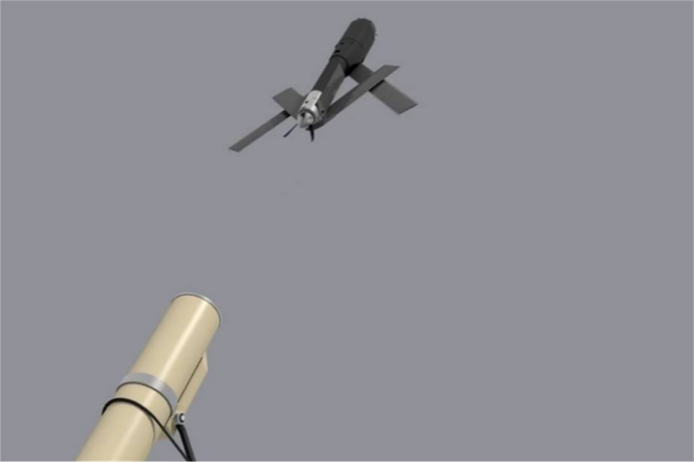
Launching a Switchblade 600
The Switchblade 600 is a loitering munition also known as an attack drone
Instead, the department relied on reprogramming requests and service-level funding embedded within existing Program Elements. An initial $300 million request in fiscal year 2024 supported early efforts, including funding for the Army’s LASSO program for Switchblade 600 loitering munitions. For fiscal years 2025 and 2026, the department shifted toward aggregated requests of roughly $500 million annually, distributed across multiple service accounts rather than consolidated into a single budget line.
This structure enabled speed at the front end—but at a cost. Because Replicator remains yoked to legacy budget processes for scaling and sustainment, it cannot escape the very mechanisms and slow traditional programs once production volumes grow. These mechanisms include:
fixed budgeting cycles and annual funding approvals,
rigid accounting rules,
milestone-driven governance and approvals,
bureaucratic procurement processes,
siloed organizations (development & operations), and
burdensome compliance and audit overhead.
Progress—But Bureaucratic Friction is Persistent
There have been genuine successes. Even though the ETV achieved a first flight within roughly 12 months of solicitation—a massive win by historical standards, the move to "scaled production" and "mass fielding" remained tethered to the two-year Planning, Programming, Budgeting, and Execution (PPBE) cycle to provide the massive funding required for thousands of units (Clark, 2024; DIU, 2024). The timelines for the Altius-600/Ghost-X drones have extended to the 24-month mark. Both platforms were already relatively mature commercial-off-the-shelf (COTS) or near-COTS systems. Taking 24 months to put existing, proven technology into the hands of soldiers in large volumes still reflects the friction of the PPBE process.
Elsewhere, however, the bureaucracy has reasserted itself. The Air Force significantly inflated the cost and schedule of a commercial-derivative loitering munition by imposing Link-16[11] integration and extreme arctic-survivability requirements. The Army encountered what officials have described as a “sustainment paradox”: it demanded full explosive-safety certification and a 12-year sustainment plan for a one-way, expendable weapon—requirements that reportedly drove at least one vendor out of the program entirely.
These cases illustrate a deeper problem: a cultural inability to treat attritable systems as consumables rather than enduring capital assets.
The Gold-Plating Math
A helpful way to conceptualize the problem is through a simple acquisition-efficiency lens (adapted from the Lean Six Sigma process efficiency formula).
E = Capability Index/ C x T
Where capability reflects performance attributes such as range, payload, sensors, and lethality, whereas C denotes cost and T denotes time.
Traditional defense acquisition has focused almost exclusively on maximizing the numerator—capability—often at the expense of cost and schedule. Replicator was intended to invert this logic by accepting “good enough” capability in exchange for dramatic reductions in cost and time. Instead, as additional requirements inflate both C and T, efficiency does not merely decline; it collapses.
Five Hard Truths the Pentagon Must Accept
Attritability is a strategy, not a price point.
Attritable systems require a fundamental shift in risk tolerance. Commanders must be prepared to lose a substantial fraction of their uncrewed inventory early in a conflict without jeopardizing mission success—an assumption increasingly validated by recent conflicts.Better is the enemy of good enough.
The “90 percent solution” runs counter to decades of acquisition culture. Evidence from Ukraine suggests that modified commercial systems with modest reliability can still deliver decisive tactical effects at scale.Eliminate the sustainment tail.
Treating attritable systems as consumable munitions eliminates the need for long-term storage, obsolescence management, and the bureaucratic overhead of lifecycle sustainment.Integration is the enemy of mass.
Requiring a $50,000 unmanned system to meet the same networking and cybersecurity standards as a $100 million stealth aircraft guarantees that it will never be fielded at scale.Quantity is the enemy’s vote.
U.S. defense assessments indicate that the People’s Liberation Army is rapidly expanding its loitering-munition and unmanned-strike capabilities, leveraging China’s vast civil-military manufacturing base, with key modernization milestones targeted for 2027.
If Replicator ultimately fails, it will not be because the Pentagon lacked technology, funding, or industrial capacity. It will fail because the Department of Defense attempted to graft a strategy of speed and attrition onto an acquisition system designed for perfection, longevity, and risk avoidance.
[1] A “new start” is a new program element, project, or major component not previously justified and funded by Congress through the normal budget process.
[11] Link 16 is a secure, jam-resistant, high-speed digital data link that enables military aircraft, ships, and ground forces to exchange their tactical picture in near-real time.